
About the Project
TFT LCDs frequently emerge during the product design phase, whether it's for a straightforward user interface like a gas pump or a more advanced system such as a medical instrument or modern infotainment system in vehicles.
The LCD design process poses numerous challenges, prompting designers to consider various aspects. They ponder over questions such as the maximum supported LCD resolution, clock rate capabilities, the necessity of SRAM and its required amount, and the impact of EMI considerations.
LCDs are notorious for causing products to fail EMI tests, raise concerns in terms of needing a Real-Time Operating System (RTOS) and power consumption. It is not uncommon for LCDs to require multiple voltage rails, some even requiring negative rails. Designers also need to determine whether the LCD should be capacitive or resistive, how to communicate with external peripherals and the MCU, and the functioning of Vsync and HSync. The challenges seem endless.
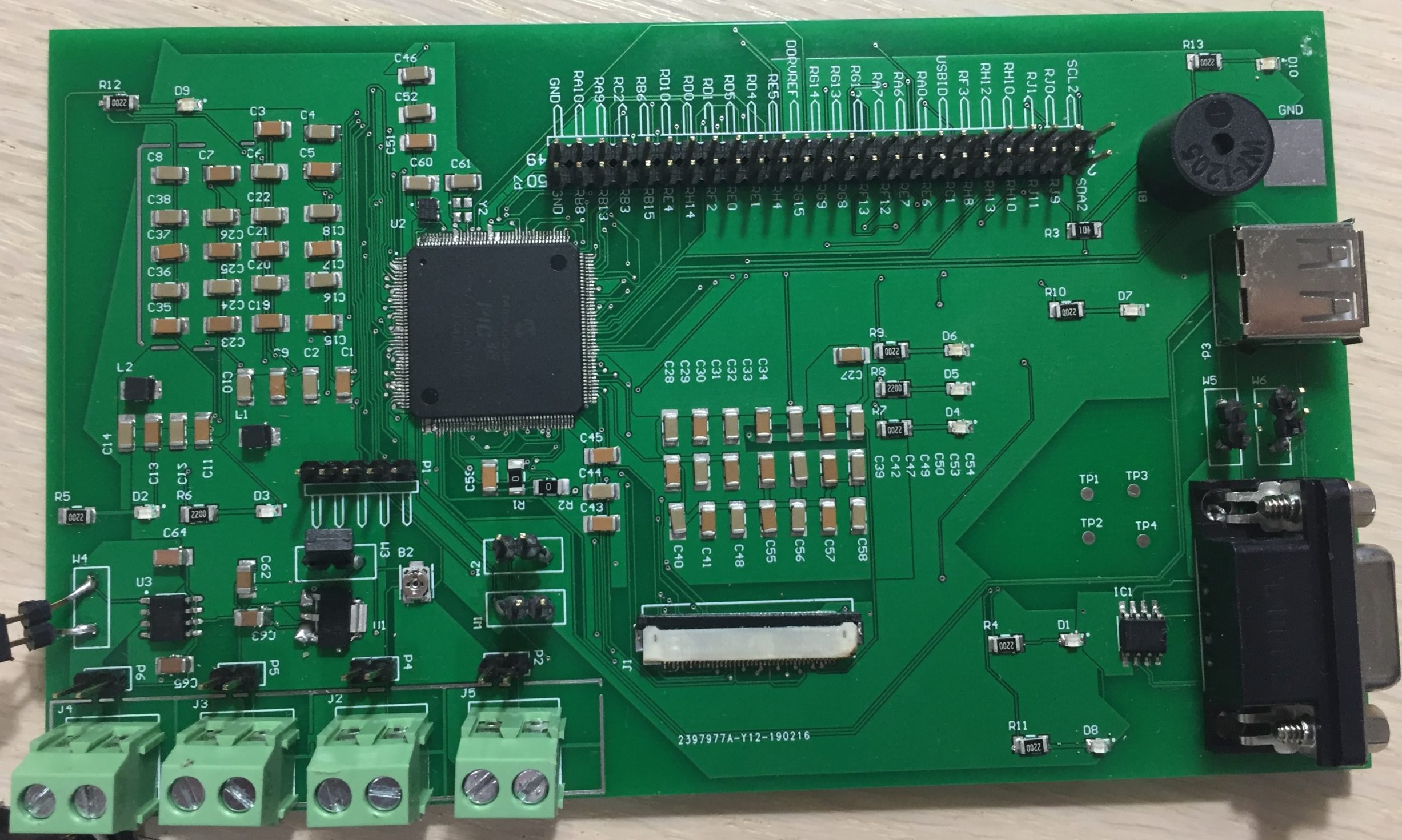
To address these complexities, the Ultimate LCD driver was conceived, simplifying the process to a plug-and-play solution. At its core lies a PIC32MX module responsible for driving the LCD, responding to UI interrupts, and facilitating communication through various protocols like USB 2.0, standard I2C (100KHz), CAN, and RS232. This enables effortless interfacing with other MCUs. Additionally, the PCB incorporates a customizable buzzer for user convenience. The board operates on a 12V input and utilizes a 40-pin TFT LCD. Through a set of regulators, users can obtain regulated 12V, 5V, and 3.3V from the terminal screw blocks located on the right side.
-
ProjectUniversal LCD Display
-
Year2020
-
RoleEngineer